

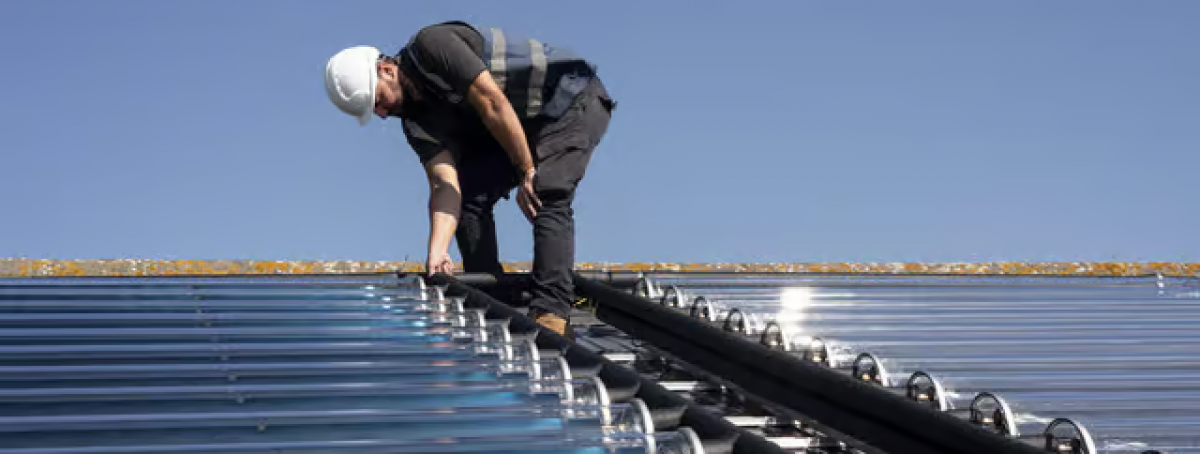
Great British Energy and Barclays Climate Ventures have announced a combined £8.875 million investment in Crawley-based Naked Energy, marking Great British Energy's first solar-related investment and signalling how the state-backed investor intends to pair public capital with existing private shareholders rather than displace them. The funding will establish a new UK manufacturing facility for Naked Energy's Virtu solar-thermal technology, creating up to 40 direct and around 100 indirect jobs.
Naked Energy is a Crawley-headquartered renewable heat technology company whose patented Virtu solar collectors generate both heat and electricity from a single rooftop system, already installed at the British Library and the All England Lawn Tennis Club.
Great British Energy is a UK government-owned clean energy investment company investing £7.5 million through its Energy Engineered in the UK programme.
Barclays Climate Ventures is the climate investment arm of Barclays, a shareholder in Naked Energy since its first investment four years ago.
Great British Energy chief executive Dan McGrail said cutting our reliance on gas is one of the biggest challenges we face, both for energy security and for keeping bills down.
The investment closes Naked Energy's £27 million Series B financing round, and marks Great British Energy co-investing alongside an existing private shareholder rather than displacing one, a pattern likely to recur as it scales its portfolio.
Heat decarbonisation remains one of the hardest components of the UK's net zero commitments to solve, since gas still serves hot water, space heating and process heat loads that heat pumps cannot always efficiently reach, particularly at the higher temperatures industrial processes require.
Naked Energy's technology sidesteps that constraint by generating heat at the point of use without adding load to grid connections already under pressure from electrification. That distinction, cutting gas demand without raising electricity demand, is precisely what Great British Energy's £8.3 billion mandate is designed to catalyse: public capital de-risking early manufacturing scale-up so private investors follow.
For the sector, backing a UK manufacturing facility rather than deployment alone signals a deliberate industrial policy layer to that mandate, prioritising domestic supply chain capacity over simply funding more installations.
Source: SussexWorld / Process & Control Engineering / GOV.UK







.png)