

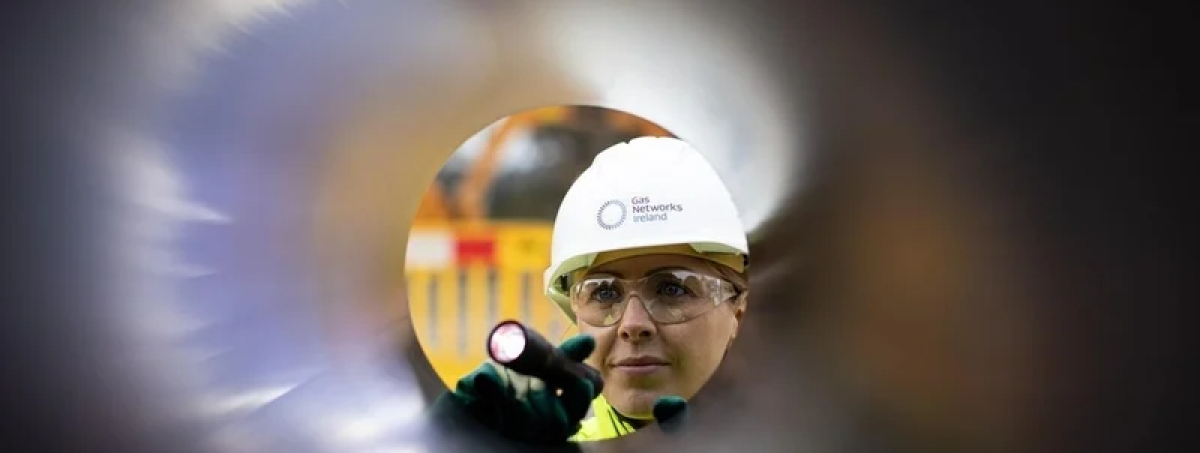
Gas Networks Ireland has opened its €32 million Central Grid Injection facility in Mitchelstown, County Cork, the first of its kind in Ireland and Europe, giving biomethane producers too far from a pipeline a route to the national gas network and removing a key location barrier for the sector.
Gas Networks Ireland is the state-owned operator of Ireland's national gas network, which has signed agreements to connect seven major new biomethane producers to its network.
College Group is a Nobber, County Meath-based bio-waste management company whose €35 million biomethane plant is among the producers contracted for connection.
Bia Energy is a Dublin-based anaerobic digestion operator whose €90 million biomethane facility is also among the seven connection agreements.
Producers can transport biomethane by trailer from independent anaerobic digestion plants to Mitchelstown, where it is prepared to the required standards and injected into the national network. At full capacity the facility can inject up to 700GWh annually, equivalent to about 12% of the Government's 5.7TWh 2030 biomethane target, and could deliver around 130,000 tonnes of CO2 savings each year.
David Kelly, chief executive of Gas Networks Ireland, said: "Having recently connected two anaerobic digestion plants in Dublin and Meath directly to our gas network, Mitchelstown now gives producers who are not close enough to a pipeline a route into the national network, helping to unlock the potential of Ireland's biomethane industry." He said investment in the Munster region will exceed €80 million.
The hub model changes the location arithmetic, because direct pipeline connections limited projects to sites near the network, while trailer-fed injection widens the catchment to farm and food waste clusters across the region. Its 700GWh ceiling is more than three times the combined capacity of Bia Energy's plant at up to 120GWh and College Group's at up to 75GWh, the two direct connections completed this year.
Industry players have said plant construction is running well behind the trajectory needed for the 2030 target.
For the sector, central injection turns grid access from a geographic constraint into a logistics choice, widening the pool of anaerobic digestion developers able to pursue a route to market.
Source: RTE / energynews.pro / The Irish Times





.png)